




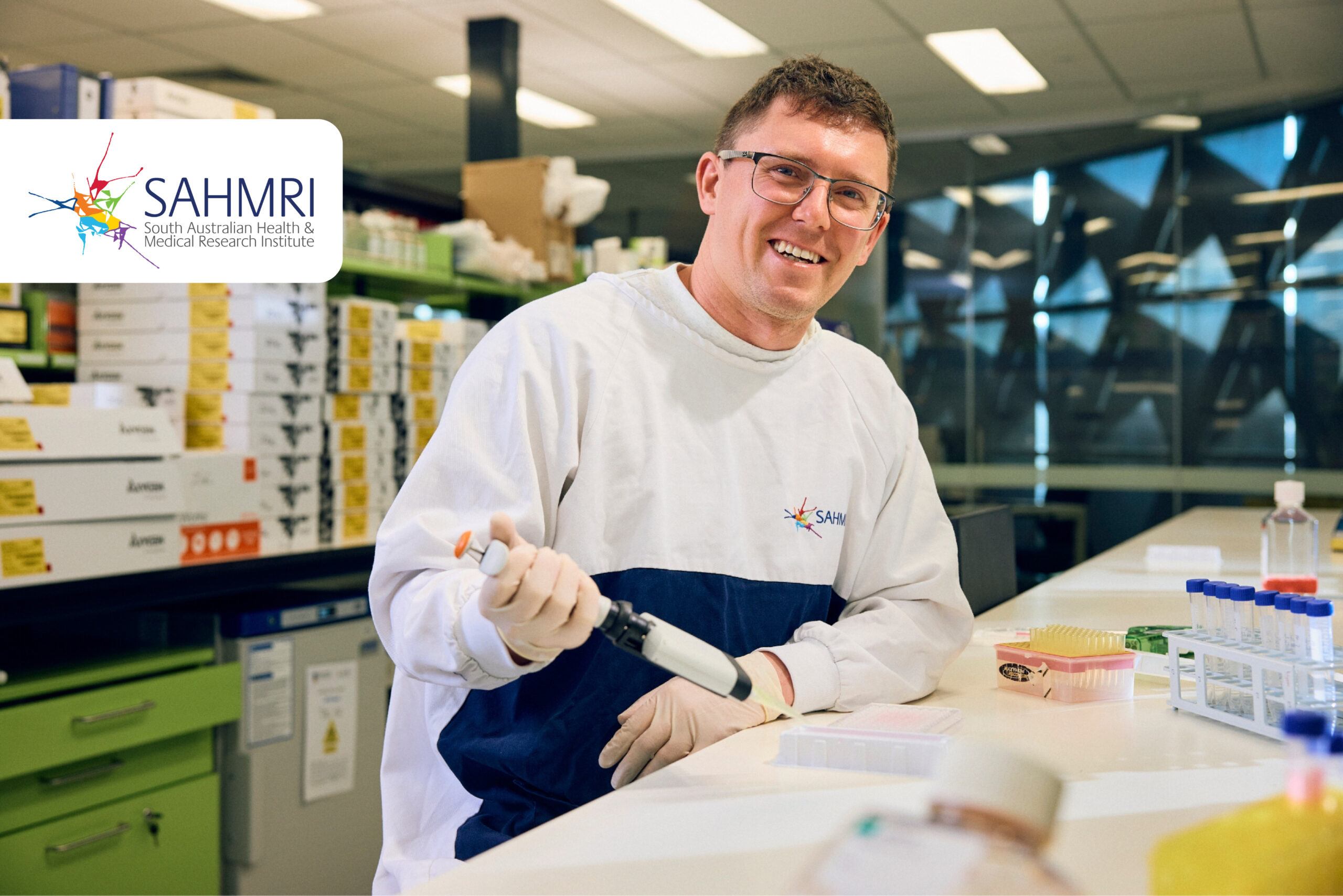
Dr Todd Norton is investigating how gut bacteria influence vaccine responses in infants — and what that means for protecting children from infection across their lives.
Dr Todd Norton
Researcher · SAHMRI
Firefly Children’s Foundation — 2026 grant recipient
Incensed in his early 20s when he finally realised just how cool science was, Todd Norton determined he would become a teacher so no other student would miss out.
“It just didn’t come across how cool science was in school,” the now Dr Norton says. “And I thought I’d become a teacher to show students just how cool it can be.”
A teacher friend steered him away, suggesting he should “have a go at actual science” first. Dr Norton is grateful he took that advice — completing a Bachelor of Science at the University of Adelaide, where lab placements and the chance to pick actual scientists’ brains sparked his passion for immunology.
After a summer research scholarship and PhD, he joined Professor David Lynn’s team in 2020 on a one-year contract. Six years later, he’s still there.
What gut bacteria have to do with vaccines
With support from the Firefly Children’s Foundation, the team is investigating how gut bacteria influence long-term health and vaccine responses in children.
Newborns treated with antibiotics in neonatal intensive care had weaker responses to vaccines during their first 15 months of life — potentially linked to a loss of Bifidobacterium, a beneficial gut bacteria.
Exactly how this bacteria supports the immune system is not yet fully understood. This project aims to answer that question, with the goal of developing new ways to better protect infants and young children from infection.
“When most people think of gut bacteria, they think it helps break down food — but it actually has a pretty big impact on how your immune system functions. That has implications for how you respond to vaccination, but also things like allergy, autoimmune diseases, or how severe an infection is if you get one.”
— Dr Todd Norton
“We’re particularly focused on children because it’s easier to try and start an intervention before a problem develops.”
Science rarely travels in a straight line
As with all research, the path from hypothesis to solution is rarely linear.
“What we often present to the public is ‘we started here and it went here’ — but often it’s all over the place, with a lot of dead ends. The challenge is that once you get stuck in those areas where you know you’ve got something to work with, but you can’t quite figure out the next step forward.”
— Dr Todd Norton
When those moments arrive, collaboration helps. The team works with partners across the globe — and Dr Norton says that coming together around a shared problem is one of the most rewarding parts of the work.
“We have external collaborators all over the world. You’ll come together to work towards a common goal. Everyone is lifting everyone else up.”
The value of being backed
While the science is complex, the impact is deeply human — and advancing that work relies on organisations willing to back emerging ideas. For Dr Norton, support from the Firefly Children’s Foundation has been pivotal, both practically and personally.
“For the Firefly Children’s Foundation to back our work provides real validation. It tells you that what you’re doing matters, that others see value in it, and that gives you a huge sense of purpose. It simply wouldn’t be possible without that support — our research just wouldn’t be happening.”
— Dr Todd Norton
As an early career researcher, that backing carries extra weight. “It can be really challenging for younger scientists to secure funding,” he says. “Support like this helps us build our careers and keep pushing forward.”
Advice for the next generation
For those considering a future in children’s research, Dr Norton’s advice is simple.
“Be curious. Ask lots of questions. The people who come in and really want to understand how everything works — they’re the ones who become the best scientists. Curiosity is one of the most important traits you can have.”
— Dr Todd Norton
Looking ahead, he hopes his work will help give children the strongest possible start to life. “Our research is focused on infants in that first year of life. We’re working towards interventions that can support the development of their immune system early on — not just here in South Australia, but globally. Ultimately, it’s about helping shape lifelong health from the very beginning.”
This article is part of Firefly’s Spotlight series, profiling researchers supported by the Firefly Children’s Foundation.